
"You've got to be ripped."
How diet culture targets men and teaches boys to hate their bodies

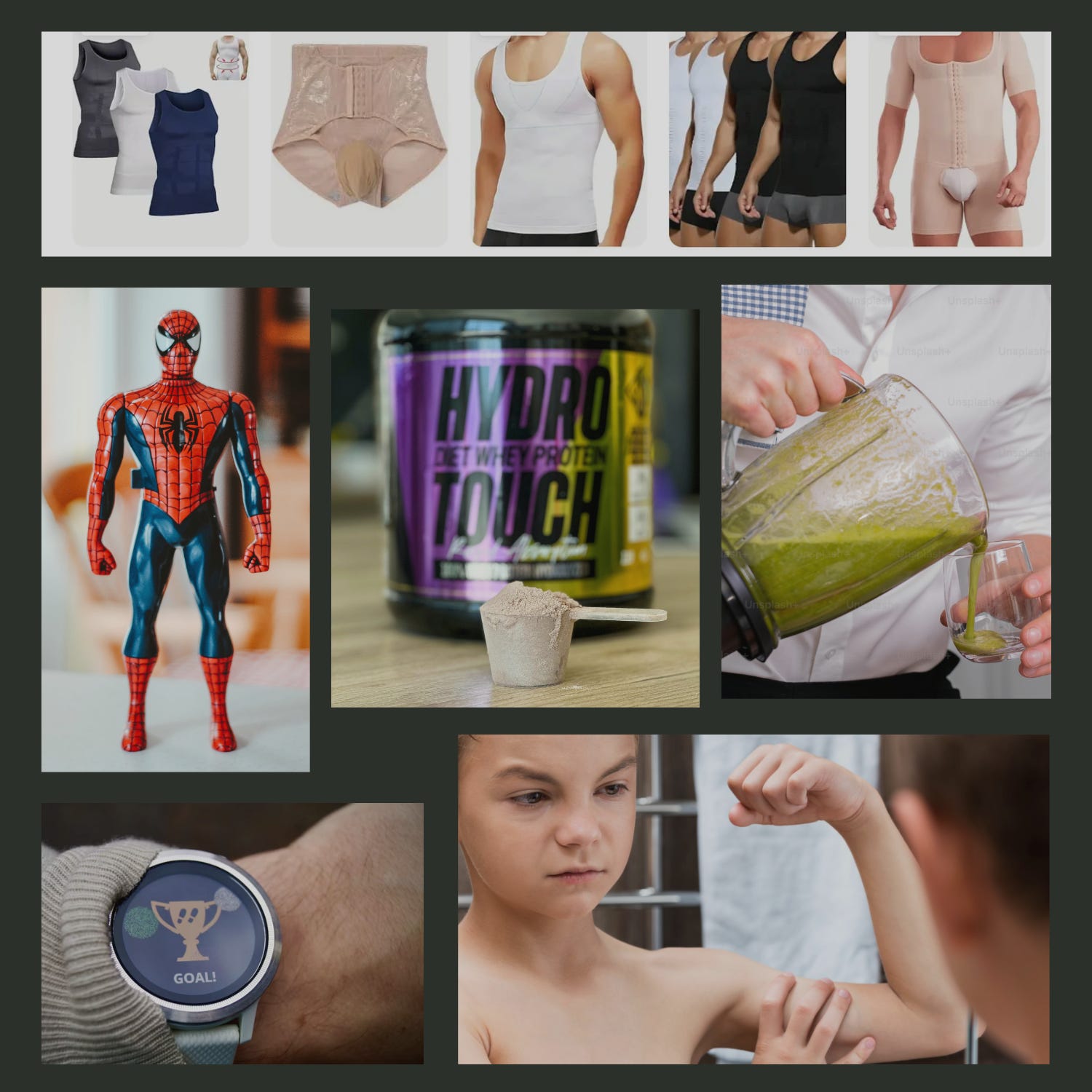
When I meet someone who learns I work with parents whose kids have eating disorders, I regularly hear this response: “I’m so glad I have boys, so I don’t have to worry about that stuff!”
I always try to find a gentle way to acknowledge why they would assume their sons are immune—and to offer some education on the topic.
Maybe you, too, would be surprised to learn that at least a quarter of those in treatment for an eating disorder are male. The actual number of men and boys suffering is certainly much higher because they’re such an under-diagnosed group.
And here’s another stat that often stops people in their tracks:
One in seven men will experience an eating disorder by age 40. (In case you’re wondering, it’s one in five for women.)1
The vast majority of men (up to 80% in some studies) report some kind of body dissatisfaction, and we’re seeing appearance concerns affecting younger and younger boys. Among middle schoolers, a staggering 75% of boys now dislike some aspect of their bodies. I heard recently from a parent with an 8-year-old who does nightly push-ups because he wants to get “ripped.”
Weight and muscularity aren’t the only sources of insecurity—height, hair, jawline, and penis size being other top concerns—but body shape is the one diet culture suggests is entirely within someone’s control. Of course, influencers also peddle “solutions” to those other supposed flaws, too.
Seeing your body as a constant self-improvement project is nothing new to most women and girls, who have had it even worse when it comes to head-to-toe appearance scrutiny. And certain manifestations of diet culture, like #SkinnyTok, specifically target young women. But ignoring the effects on men and boys doesn’t help anyone.2
Eating disorders are already notoriously tricky to spot, especially in a culture that praises restriction. Gender stereotypes make it that much harder to recognize when boys and men are struggling in their relationship to food, exercise, or their body.
While most parents would hear alarm bells if their teen daughter started taking diet pills and following a rigid exercise regimen, many wouldn’t raise an eyebrow if their son started using supplement powders and spending hours at the gym. It’s a given that boys, especially athletes, will be concerned, even preoccupied, with fitness.
Disordered behaviors—like “bulking and cutting,” having “cheat days,” and (non-religious) fasting—are the norm among many adolescent boys. Now that obsessive tracking of protein intake has become widespread across genders and generations, a teen boy’s fixation on a particular macronutrient hardly stands out as unusual.
It’s not just parents and coaches who don’t notice red flags in boys. Even doctors can miss—or even dismiss—glaring symptoms because the patient in front of them doesn’t look like the image presented in the brief lesson on eating disorders in medical school. Even the official symptom criteria for an anorexia diagnosis included amenorrhea until 2013 (amenorrhea is the loss of a period in someone who would normally be menstruating).
I’ve worked with families who brought their sons to the pediatrician because their teen’s workouts and new eating rituals seemed to be taking over their life and altering their personality—only to be told their child’s dangerously slow pulse was just the sign of “an athlete’s heart.” Thanks to parental intuition and advocacy, these boys eventually received a diagnosis and treatment.
Because stereotypes and stigma lead to delayed diagnoses, boys and men tend to be so much sicker when they do finally get treatment. And as diet culture has ratcheted up its pressures on how men “should” look and “should” eat, it’s no wonder hospitalization rates for boys with eating disorders have skyrocketed in recent years.
In many ways, we shouldn’t be surprised. Once the diet/wellness industry realized they had been missing out on selling body dissatisfaction and diets to half the population, this previously untapped customer base started being targeted with aggressive and seductive marketing. “Dieting” was cleverly rebranded for men as biohoacking, performance optimization, and longevity protocols.
Masculine-coded products promising fat loss and muscle building are no longer tucked away in the body-builder aisles of your local GNC. Grocery stores and pharmacies now carry unregulated supplements featuring words like “Hardcore,” “Extreme,” and “Maximum Intensity” in bold letters on black packaging. For guys who identify more with the tech bro than the gym rat, intermittent fasting and expensive wellness powders are promoted as advanced biotechnology.
No matter what it’s called or how it’s marketed, restriction and complicated rules around food (that aren’t medically necessary) are forms of disordered eating that can become a serious mental illness.
Boys and men get all the same eating disorders as girls and women (e.g., anorexia, bulimia, binge eating disorder, ARFID), and they also are at risk for a kind of body dysmorphia that affects males almost exclusively: “bigorexia,” a pathological obsession with muscularity and leanness that often accompanies eating disorder symptoms.
Our culture’s approach to food—made all the more complicated by fear-mongering and misinformation—has made eating feel like navigating a minefield for so many men and boys. Will this protein bar help me “enhance performance”? Or is it full of “toxic” ingredients?
And all of this effort to pursue biological optimization on the inside—“from a cellular level”—comes hand-in-hand with heightened expectations around outward appearance.
You’re probably well versed in the way beauty standard goal posts keep moving for women, but it’s easy to forget how they affect men, too.
One of the most powerful ways to see the evolution of the “ideal” male physique is to consider representations of men’s bodies in popular culture. Author and eating disorder recovery advocate Ryan Sheldon has some great slides to illustrate this point:
Imagine being a boy going through puberty amidst all of this noise about how to look and how to eat. You’re trying to figure out who you are and how you can fit in (or stand out), all while your body is going through a rapid period of growth and change that requires a lot of energy.
Yet many of the men you admire convey the message that looking “cut” and “shredded” is the only way to be—and that it’s manly to micromanage your food to try to get there. At the same time, you’re hearing that these thoughts and behaviors can harm your mental health only if you’re a girl.
For parents who want to protect their sons, the most important first step is having this awareness that boys can struggle with eating and negative body image. Understanding the risks that come with intense external pressures can help motivate families to make their homes a safe haven from body shaming and rigid food rules.
If your gut tells you something doesn’t seem right with your son, listen—and get support.
Also, remember that eating disorders and negative body image aren’t problems that plague only adolescents. Younger boys and men of all ages struggle with these issues, too.
Until we start to push back on the myths and stereotypes about what body dysmorphia and eating disorders supposedly “look like,” too many people will continue to suffer alone. We can all do our part to start changing the cultural narrative so that everyone has a chance to feel good in their own skin.
Related reading and resources:
Being You: The Body Image Book for Boys by Charlotte Markey, Daniel Hart, and Douglas Zacher
The Unscripted Journey newsletter from Aaron Flores RDN
Dads affect kids’ body image, too
CNN Opinion piece about how mocking Trump’s appearance hurts other men and boys
I’m wishing a happy Father’s Day to all the dads and father figures out there. I hope you feel loved and worthy just as you are. And if you’re struggling in your relationship with food, your body, or exercise, know that you aren’t alone and deserve support.
Ward ZJ, Rodriguez P, Wright DR, Austin SB, Long MW. Estimation of Eating Disorders Prevalence by Age and Associations With Mortality in a Simulated Nationally Representative US Cohort. JAMA Netw Open. 2019 Oct 2;2(10):e1912925. doi: 10.1001/jamanetworkopen.2019.12925. PMID: 31596495; PMCID: PMC6802241.
This piece focuses specifically on boys and men. Of course, gender identity and even biological sex are much more complicated than the familiar binary. It’s worth noting that trans folks have even higher rates of eating disorders than their cis peers. For resources and support specifically for trans people with eating disorders, check out FEDUP.
That superman pic is striking! And, of course, you know I agree with you about all the rest.
A few weeks into my new position in a children's hospital and we've had nearly as many male patients as female w eating disorders.
Thanks for mentioning The Body Image Book for Boys! I wish that all homes with preteen/teen boys had a copy of it in their home, right next to a puberty book of choice, and a book about consent/sex. Tik Tok is not the optimal place for kids to be getting health information!
as I get older a funny term to me is "dad bod".
men who aren't at the pinnacle of competitive bodybuilding are described as "dad bod"
15% body fat, 6 minute mile, etc.
workout every day.
I would absolutely have to take supplements and train like a professional athlete -whose livelihood is their physique- to get beyond that label.